
Ammo Prices: Cost Per Round by Caliber
Home › Ammo Prices By Mendy Segelman, Tactical Surplus USA · Data as of October 21, 2026 · Published October 21, 2026 The Tactical Surplus USA Ammo Price Index is a monthly snapshot of what in-stock ammunition actually costs in our catalog, measured the way most shooters shop: cost per round. Each month we take every in-stock, visible listing for the calibers we track, convert it to a price per round (per shell for shotguns), and publish the median, the cheapest 10%, the lowest and highest prices, and how many SKUs went into each number. This page explains how to use those numbers. The October 2026 report has the full tables and chart, and the methodology page explains exactly how they are built. Prices are listed prices in USD before shipping and tax, Tactical Surplus USA catalog only, as of October 21, 2026. "Withheld" means fewer than 10 in-stock SKUs in that group. .22 LR is withheld this month (8 in-stock SKUs). Caliber names link to the matching Tactical Surplus USA category. Ammunition is sold in boxes of 20, 50 or 100, in bricks, and in cases of 500 to 2,000 rounds or more. Sticker prices alone can't tell you which is the better buy. Cost per round can: divide the price by the number of rounds in the unit you're buying. Cost per round = price ÷ rounds in the unit Worked example using the October 2026 9mm range median of $0.28 per round: a 50-round box at that rate is about $14.00, and a 1,000-round case is about $280.00. Run the same math on any listing and you can compare it directly to the table above. For shotgun shells, divide by the number of shells to get cost per shell. Two habits make the comparison fair. First, compare like with like: price range ammo against range ammo and defensive loads against defensive loads. Second, decide whether you're comparing listed prices or delivered prices. Our index uses listed prices before shipping and tax, so add those costs to both sides if you want to know what a box costs at your door. The single biggest driver of cost per round is what the ammo is built to do. That's why the index splits every caliber into range and defense instead of publishing one number. In October 2026 the gap is large. 9mm range has a median of $0.28 per round, while 9mm defense has a median of $1.13. For 12 gauge, range has a median of $0.55 per shell and defense $2.03 per shell. Why the blended number can mislead. The index also reports a blended median across every SKU in a caliber. For 9mm that's $0.89 per round across 99 SKUs, more than three times the range median. The reason is mix, not price: Tactical Surplus USA lists 55 defensive 9mm SKUs and 13 other SKUs against 31 range SKUs, so the middle of the combined list falls among defensive loads. If you're buying practice ammo, use the range median. Case material is the next thing to check. Steel-cased ammo is common in 7.62x39, 9mm and .223, and it's generally priced below comparable brass-cased ammo because steel is cheaper to make into cases. Brass costs more, but it's the material reloaders want, because brass cases can be resized and reused. The October 2026 index doesn't split prices by case material, so we don't publish a steel-versus-brass figure. When you compare two range loads, check the case type in the listing title before you decide one is a better deal. A steel-cased round and a brass-cased round at the same cost per round are not the same product. Also check whether your firearm or range allows steel-cased ammo before you buy it in bulk. Buying by the case usually lowers cost per round, because packaging and handling are spread over more rounds. But a case listing isn't automatically cheaper than a box listing, so do the math on both. One detail matters for reading the index. Some listings show two counts, such as 20/500: a box of 20 sold from a 500-round case. When the unit you add to the cart is the box, the index prices it per round of the box, not of the case. That keeps the figure tied to what you actually pay for what you actually get. Because October 2026 is the first snapshot, there's no month-over-month change yet. From November 2026 on, each report will show how the median moved. The index uses a read-only snapshot of the Tactical Surplus USA catalog, filtered to a verified list of loaded ammunition. A listing counts only if it's in stock, visible, and has a positive price and a readable round count. Each SKU gets one price per round, and the median, 10th percentile, minimum and maximum are calculated across SKUs. Groups with fewer than 10 in-stock SKUs are withheld, and a median that moves more than 25% from the prior month is held for review before publication. Read the full methodology. Buying ammunition online for the first time? Our guide to how to buy guns online walks through the ordering process. Cost per round is the price of a box or case of ammunition divided by the number of rounds in it. It lets you compare a 50-round box with a 1,000-round case on equal terms. For shotgun shells the same math gives cost per shell. Divide the price by the round count. For example, at the October 2026 9mm range median of $0.28 per round, a 50-round box works out to about $14.00 and a 1,000-round case to about $280.00. Compare listings before shipping and tax, or include them in both prices if you want a delivered cost. As of October 21, 2026, the median in-stock 9mm range (FMJ) price at Tactical Surplus USA is $0.28 per round across 31 SKUs, and the cheapest 10% of those listings are $0.25 per round or less. Defensive 9mm has a median of $1.13 per round across 55 SKUs. The blended figure ($0.89 per round across 99 SKUs) mixes inexpensive range ammo with premium defensive and other loads. Because Tactical Surplus USA stocks more defensive 9mm SKUs than range SKUs, the blended middle lands in defensive territory. If you are buying practice ammo, use the range median. Defensive loads use jacketed hollow point bullets engineered to expand, are usually sold in smaller boxes of 20 to 50 rounds, and are made in smaller production runs than bulk FMJ. In this index, 9mm defense has a median of $1.13 per round versus $0.28 for range, and 12 gauge defense has a median of $2.03 per shell versus $0.55 for range. Tactical Surplus USA only publishes a price figure when at least 10 in-stock SKUs are in a group. In October 2026 that rule withholds 5.56/.223 defense, 7.62x39 range and defense, and all .22 LR figures. The SKU counts are still shown so you can see the sample size. No. The index covers only the Tactical Surplus USA catalog, using listed prices before shipping and tax on October 21, 2026. It tells you what a typical in-stock load costs here, not what every retailer charges. The index is published monthly. October 2026 is the first snapshot, so there is no month-over-month change yet. Each new month gets its own report page, and this page always links to the latest one. Data: Tactical Surplus USA, licensed CC BY 4.0. You may reuse the figures with credit to Tactical Surplus USA and a link to this page. Own-catalog data, not a market-wide price.October 2026 Cost Per Round by Caliber
Caliber
Range (FMJ) median
Range cheapest 10%
Defense median
Blended median
In-stock SKUs (all)
9mm
$0.28 per round
$0.25 per round
$1.13 per round
$0.89 per round
99
5.56/.223
$0.61 per round
$0.46 per round
withheld (under 10 SKUs)
$0.67 per round
70
7.62x39
withheld (under 10 SKUs)
withheld (under 10 SKUs)
withheld (under 10 SKUs)
$0.86 per round
16
12 gauge
$0.55 per shell
$0.41 per shell
$2.03 per shell
$0.87 per shell
324
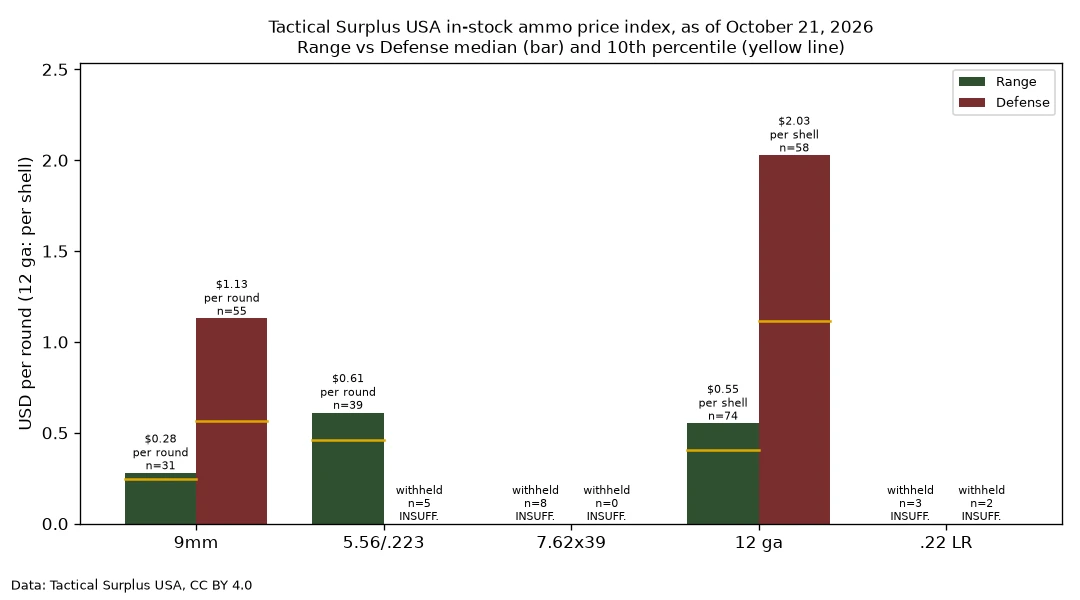
What Cost Per Round Means and How to Calculate It
Range Ammo (FMJ) vs. Defense Ammo (JHP)
Steel Case vs. Brass Case Pricing
Bulk and Case Pricing vs. Box Pricing
How to Read the Ammo Price Index
How the Index Is Built
Shop by Caliber
Ammo Price FAQ
What does cost per round mean?
How do I calculate cost per round?
What is the median price of 9mm range ammo at Tactical Surplus USA?
Why is the blended 9mm median so much higher than the range median?
Why is defense ammo more expensive than range ammo?
Why are some calibers marked withheld?
Is this a market-wide ammo price?
How often is the ammo price index updated?
Data and Downloads